

A Missing Verse In Psalm 145!
Asher Chee |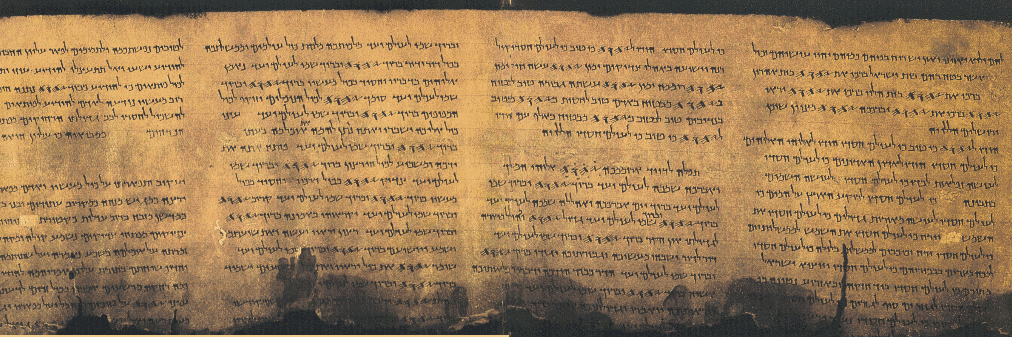
Psalm 145 is an alphabetic acrostic. This means that in the original Hebrew text, each verse begins with successive letters of the Hebrew alphabet. Thus,
- Verse 1 begins with the first letter of the Hebrew alphabet, ʾāleph.
- Verse 2 begins with the second letter of the Hebrew alphabet, bēyṯ.
- Verse 3 begins with the third letter of the Hebrew alphabet, gimel.
- ...
This pattern continues so on and so forth until the last verse of Psalm 145, which begins with the last letter of the Hebrew alphabet, tāw.
The Masoretic Text is the tradition Hebrew text of the Jewish Scriptures (Old Testament). It is used by most Jews and Christians as the authoritative Hebrew text of the Jewish Scriptures / Old Testament.
In the Masoretic Text of Psalm 145, one verse seems to be missing! Verse 14 is supposed to begin with the fourteenth letter of the Hebrew alphabet, nūwn. Instead, it begins with the fifteenth letter of the Hebrew alphabet, sāmeḵ. Thus, it seems that there is a missing verse in between verses 13 and 14.
Where is this nūwn verse? It seems to be missing! Now, it is certainly possible that the original author of Psalm 145 had intentionally left out the nūwn as he was composing the acrostic. However, this is unlikely.
The Witness of the Septuagint
In the Septuagint, there is an “extra verse” in between verses 13 and 14—exactly where we would expect to find the nūwn verse:
Πιστὸς κύριος ἐν τοῖς λόγοις αὐτοῦ καὶ ὅσιος ἐν πᾶσι τοῖς ἔργοις αὐτοῦ.
The Lord is faithful [pistos] in all his words, and holy in all his works.
The first Greek word of the verse is Pistos (Πιστὸς), which means “Faithful”. It could be a translation of the Hebrew word neʾĕmān (נאמן), which starts with the letter nūwn. This may indicate that the Septuagint translators were translating from a Hebrew text which did contain the nūwn verse.
This is very important because the Septuagint is more than a thousand years older than the Masoretic Text. Therefore, in passages where the Septuagint differs significantly from the Masoretic Text, it is possible that the Septuagint reflects the original reading of the passage better than the Masoretic Text.
Because we do not have the Septuagint’s Hebrew text, the existence of the nūwn verse in the original Hebrew text remained only a speculation—until the discovery of the Dead Sea Scrolls in 1947.
The Witness of the Dead Sea Scrolls
The Dead Sea Scrolls manuscript 11Q5 contains Psalm 145. In between verses 13 and 14, we finally find a Hebrew text of the nūwn verse:
נאמן אלוהים בדבריו וחסיד בכל מעשיו
God is faithful in his words, and gracious in all his works.

The ancient independent agreement between the Septuagint and the Dead Sea Scrolls makes it reasonable to think that the Masoretic Text is mistaken, and that the original Hebrew text of Psalm 145 did indeed contain the nūwn verse.
The Nūwn Verse Today
Following the discovery of the Dead Sea Scrolls, most modern Bible translations now include the nūwn verse in Psalm 145. However, since nobody wanted to renumber the verses of Psalm 145, the nūwn verse was simply included as part of verse 13.
Many people still use old Bible translations which do not include the nūwn verse, like the KJV. When the KJV is put in parallel with the ESV, it leaves a gap because the ESV has the nūwn verse:
| English Standard Version | King James Version |
|---|---|
| 13 Your kingdom is an everlasting kingdom, and your dominion endures throughout all generations. [The LORD is faithful in all his words and kind in all his works.] |
13Thy kingdom is an everlasting kingdom, and thy dominion endureth throughout all generations. |
| 14 The LORD upholds all who are falling and raises up all who are bowed down. |
14The Lord upholdeth all that fall, and raiseth up all those that be bowed down. |
Conclusion
Critics of the Bible like to point out that we no longer have the original manuscripts of the Bible today, but only copies of copies of copies, produced by imperfect human copyists who made mistakes as they copied the biblical texts—sometimes even leaving out entire verses! While this is certainly true, it does not mean that we can never know what the original texts of the Bible contained, and the “missing” verse of Psalm 145 is a beautiful demonstration of that.