

The Story of Korah’s Descendants
Asher Chee |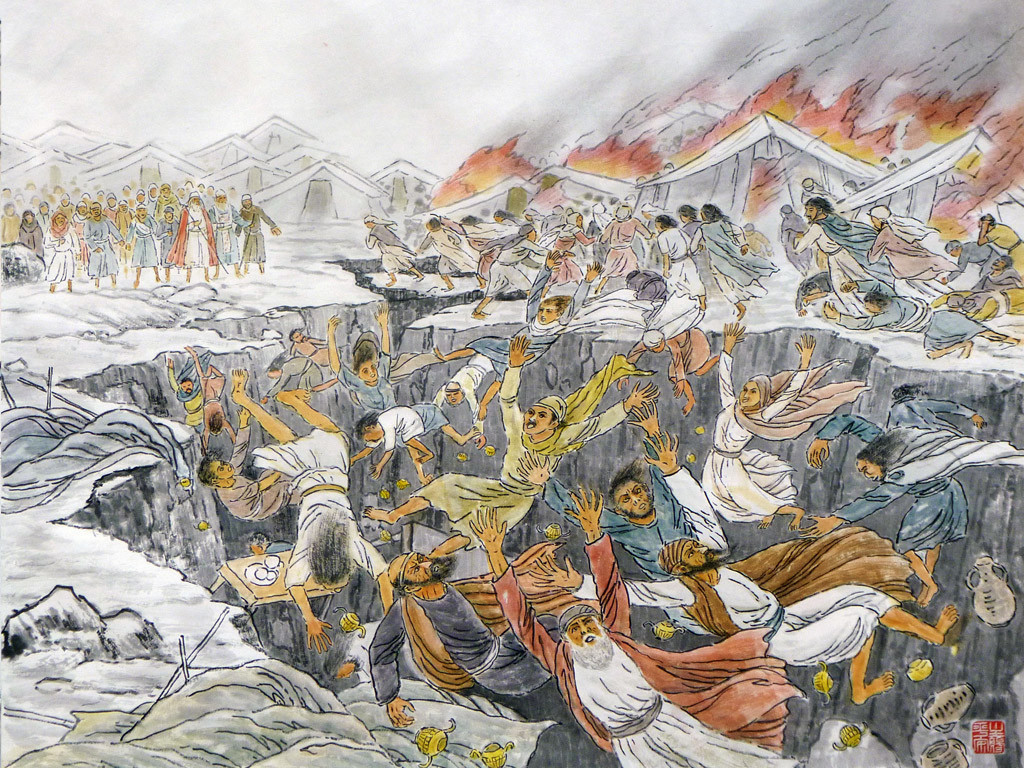
In Numbers chapter 16, we read the story about Korah’s rebellion: Korah was displeased with Moses and Aaron. He reasoned that Moses and Aaron should not have authority as leaders over all the other Israelites, since all Israelites were equal. So, Korah staged a rebellion against God together with many other supporters. In response, God sent judgement: the ground opened up and swallowed up Korah, his supporters, and their families—and they all died (vv. 32–33).
Yet, this was not the end for Korah’s family. The story of Korah’s rebellion is told again later on, in Numbers 26. In verse 11, we find it written,
But the sons of Korah did not die.
This means that some of Korah’s children did not die with Korah!
In the Scriptures, we find that Korah’s descendants grew into a family that faithfully served God:
- Some of them guarded the Tabernacle’s threshold (1 Chron. 9:19).
- Some of them were responsible for baking the offering bread for each Sabbath (1 Chron. 9:31).
- Some of them were musicians and singers in the Temple (1 Chron. 6:31-38).
- Even the great prophet Samuel was a descendant of Korah (1 Chron. 6:33, 37)!
We also find something very special in the Book of Psalms. Several biblical psalms were written “by the sons of Korah”, or Korah’s descendants—Psalms 42, 44, 45, 46, 47, 48, 49, 84, 85, 87, and 88.
Some of these psalms are well-known:
- Psalm 42 begins, “As a deer pants for streams of water, so my soul yearns for you, O God!”
- Psalm 46 begins, “God is a refuge and strength for us; a help that is surely found in troubles!”
Psalm 84 is another psalm written by the sons of Korah. Verse 11 says,
A day in your courts is better than a thousand. I prefer to be at the threshold of the house of my God than to dwell in tents of wickedness.
On its own, this verse can seem like just a statement that it is good to be in God’s house. However, it actually references Korah’s rebellion.
In Numbers 16:26, before God sent his judgement on Korah and his supporters, Moses warned the Israelites,
“Please turn away from the tents of these wicked men, and do not touch anything that belongs to them. Otherwise, you will be swept away in all their sins!”
Many Israelites obeyed Moses’ warning, including some of Korah’s children. Notably, Moses called the dwelling places of Korah and his supporters, “the tents of these wicked men”. Korah’s descendants used the same language in Psalm 84:11: they did not want to “dwell in tents of wickedness”, following in disobedience of their rebellious ancestor, Korah. Instead, they preferred to “be at the threshold of the house of my God”, fulfilling their family’s role by guarding the Tabernacle’s threshold (1 Chron. 9:19).
During ancient times, children would normally follow in the way of their parents, especially out of respect for them. Yet, when Korah rebelled against God, some of Korah’s children did not follow their father, Korah. Instead, they chose to obey God. So, when the land opened up and swallowed up Korah and his supporters, these obedient children of Korah did not die with Korah.
Korah’s family could have been remembered only for rebellion of their ancestor, Korah. Yet, because of their obedience, they are instead remembered for their faithful service to God and their beautiful psalms that are found in the Scriptures. The story of Korah’s descendants teaches us that each of us has the opportunity to love and serve God—even if the rest of our family chooses to go in a different way.